1. Project Title & Company Review
Fratellos Front Cafe: Sales Performance Analysis.
Fratellos Front Cafe is a multi-location café offering a wide range of drinks, snacks, and light meals. Over the past year, the business experienced strong growth, but that growth introduced operational pressure as the café scaled to meet increasing customer demand. Each location serves a slightly different customer mix and shows different performance patterns, making it difficult to manage menu strategy, staffing, and inventory consistently across the city.
Role: Sales Analyst

2. Business Problem
The company needed answers to key performance and operational questions:- Which menu items perform best across locations?
- What customer profile spends the most (age, gender, preferred product)?
- How can stock management reduce “out of stock” situations while also limiting overstock?
- Are there location or employee performance gaps that require attention?
3. Business Objectives
- Identify the top-selling products and the products generating the most revenue.- Determine the customer demographic generating the highest revenue.
- Identify locations/employees performing above or below the average sales target.
- Analyze customer feedback to find common themes driving satisfaction or dissatisfaction.
4. My Approach
Data collection and cleaningData analysis and insight generation
Dashboard building (KPIs, pivots, slicers, and visuals)
Recommendations tied directly to performance drivers
Tool Used: Microsoft Excel
5. Key Deliverables
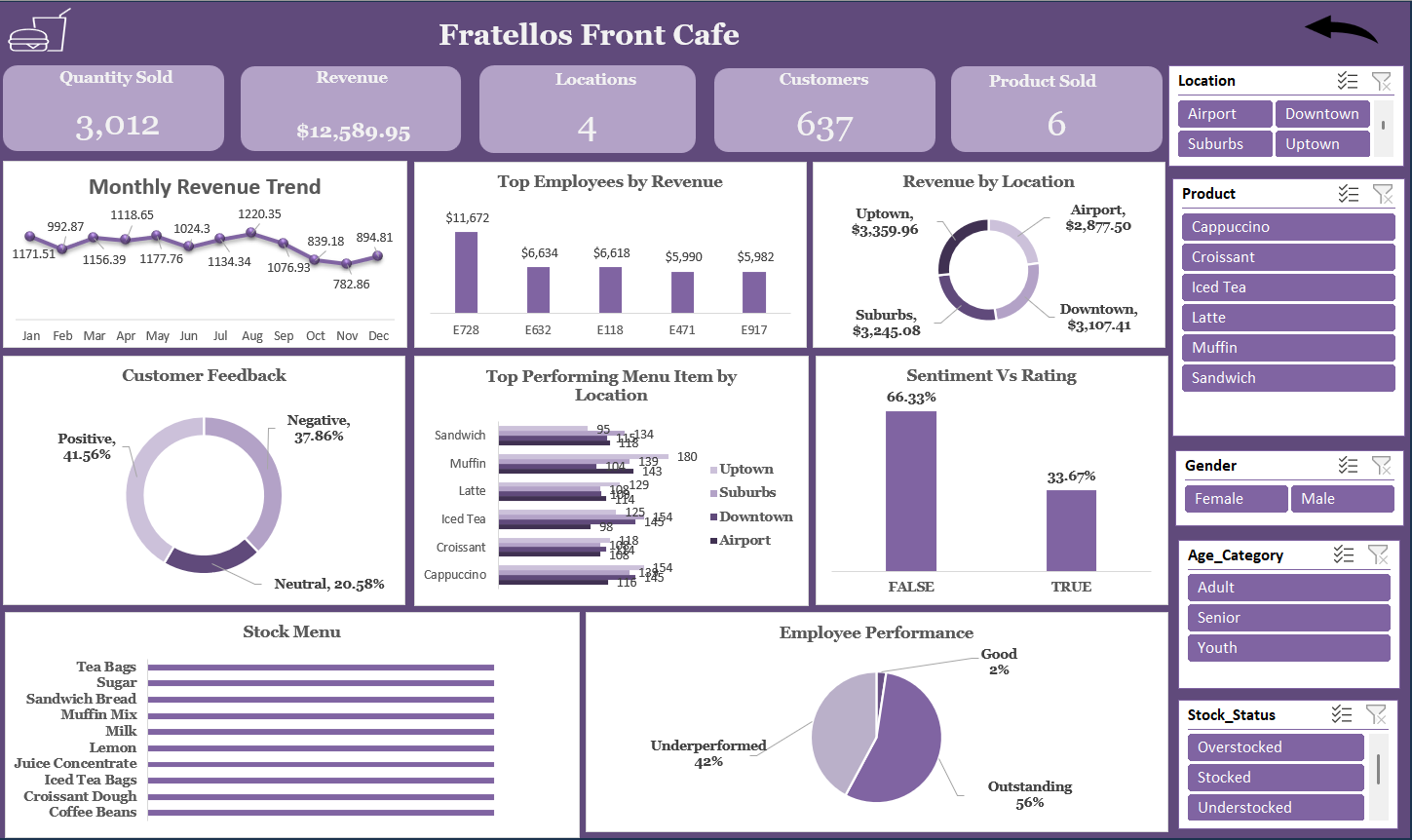
Delivered an interactive Excel dashboard to improve decision-making across:Product performance (revenue, quantity, customer reach) Location performance comparisons|| Customer demographic segmentation|| Employee performance distribution|| Stock health overview (understock/overstock signals)|| Customer rating/sentiment summary.
6. Insights & Recommendations
1. Insight: Overall, the café is performing well, but its success is heavily driven by a small number of best-selling items. Muffins, cappuccinos, and iced tea account for a large share of total revenue, meaning the business is relying on a few core products to carry growth. While this is a strength, it also increases risk if these items are unavailable or if execution slips.Recommendation: Reduce over-reliance on a few hero products
The café should protect its top-selling items by introducing stricter inventory controls and quality checks for Muffins, Cappuccinos, and Iced Tea. At the same time, management should actively promote secondary products through bundles, limited-time offers, or add-on discounts to diversify revenue and reduce risk if a best seller becomes unavailable.
2. Insight:Uptown stands out as the strongest location in terms of revenue, even though sales across all locations are fairly close. Because Uptown contributes the most, it is also the most exposed—any staffing, service, or inventory issues there are likely to have a larger impact on overall performance.
Recommendation: Strengthen operational focus at the Uptown location
Since Uptown generates the highest revenue, it should receive priority in staffing, training, and inventory allocation. Management should monitor this location more closely with weekly performance reviews, faster stock replenishment cycles, and proactive scheduling to prevent service breakdowns during peak periods.
3. Insight: Demand is not consistent throughout the year. August shows the strongest sales, while November is the weakest, pointing to seasonality or event-driven behavior. This suggests that inventory and staffing decisions should be adjusted by period and location rather than relying on fixed, one-size-fits-all planning.
Recommendation: Adjust planning to reflect seasonal demand patterns
Inventory and staffing plans should be aligned with seasonal trends rather than fixed monthly assumptions. Higher stock levels and labor coverage should be planned ahead of peak periods like August, while leaner planning should be used during slower months such as November to reduce waste and unnecessary costs.
4. Insight: Customer spending is spread fairly evenly across age groups, with adults and seniors contributing slightly more. Female customers, however, account for a higher share of total revenue. This indicates the café has a broad customer base, but there is room to better tailor promotions and bundles to the segments already driving the most value.
Recommendation: Tailor marketing toward high-value customer segments
Marketing efforts should be refined to better engage female customers and adult and senior segments, who contribute slightly more to total revenue. Targeted promotions, loyalty incentives, and product bundles designed around their preferences can help increase repeat visits without alienating other age groups.
5. Insight: Inventory management appears misaligned with actual demand. Several high-demand items are understocked, while slower-moving items are overstocked. This likely explains ongoing stock-out issues and points to the need for reorder decisions based on real sales patterns rather than assumptions.
Recommendation: Rebuild inventory rules using sales velocity
Reorder points should be recalculated using actual sales data instead of static thresholds. Fast-moving items should have higher minimum stock levels, while slow-moving products should be ordered in smaller quantities. This approach will reduce stock-outs on popular items while freeing up cash tied to excess inventory.
6. Insight: Customer feedback reveals inconsistency in the overall experience. While positive ratings slightly outweigh negative ones, the large mismatch between ratings and sentiment suggests customers may like the products but feel let down by service, wait times, or availability. This points to process and execution issues rather than product quality alone.
Recommendation: Standardize customer feedback and improve service consistency
The café should standardize how customer feedback is collected and interpreted to reduce rating-sentiment mismatches. In parallel, management should address operational drivers of dissatisfaction—such as wait times, staff interactions, and product availability—to ensure the customer experience matches the quality of the products.
7. Insight: Finally, employee performance data highlights a capability gap, particularly at the Uptown location. A significant portion of staff there are marked as underperforming, which aligns with higher pressure at the busiest site and signals the need for focused training, staffing adjustments, or operational support.
Recommendation: Address employee performance gaps, especially at Uptown
Targeted coaching and training programs should be introduced for underperforming staff, with a focus on the Uptown location. Management should review workload distribution, staffing levels, and shift structure to reduce burnout at high-traffic locations and improve overall service quality.